



I’ve always been a reader and a writer.
Since I was a little girl.
Before I had language for God’s voice or spiritual formation, books were how I made sense of the world. Writing was how I processed what I noticed, what I felt, and what I didn’t yet understand.
I didn’t know it then, but this would become the foundation of how the Lord taught me and how He spoke to me.
Around 2011, I began reading faith-based books of all kinds. I wasn’t just consuming ideas. I was paying attention. I would read a concept and then sit with its scriptural grounding.
Scripture wasn’t absent from the process.
It just wasn’t where I started.
I know this runs counter to how many are taught. Most people are instructed to begin with the Word and stay there. But the Lord knew how He had wired me.
He knew my neurodivergent ADHD brain.
My love of learning.
The way I naturally absorbed truth through story, framework, and synthesis.
Looking back, I can see something clearly now.
God didn’t start with how I should learn.
He started with how I already did.
When I was younger, Scripture often felt flat to me. Not untrue. Not irrelevant. Just inaccessible. I remember sitting in church as a child, listening to preachers read a verse and explain it, and feeling like I was missing the doorway into the text. I could hear the words, but I didn’t know how to enter them.
Books helped me do that.
Even non-fiction personal development books became bridges. I would read something about leadership or purpose, and suddenly Scripture made sense in a new way. The Lord would use what I was currently reading to illuminate what I had heard my whole life but never fully grasped.
Later, when I participated in my first formal Bible study as an adult, I felt even more confused. I did well on paper. I was at the top of the class. I knew the answers. I could keep up.
But the study relied heavily on Daily Bread devotionals, trivia, and surface-level recall. Memorizing that there were sixty-six books in the Bible or learning how to pronounce difficult names didn’t help me understand the Word.
I didn’t need more information.
I needed tools.
Tools to excavate Scripture.
To trace themes.
To understand context.
To see how the Bible speaks across story, culture, and time.
And then there was writing.
What began as escapism when I was a little girl slowly became my secret place with God.
Pen to paper was where things flowed. Not structured. Not planned. I would sit down to write and suddenly feel like I had tapped into something deeper. Words would come quickly, fully formed, without effort.
At the time, I didn’t recognize this as hearing God.
I was just writing.
Handwritten message I wrote to my little brother when he was five.
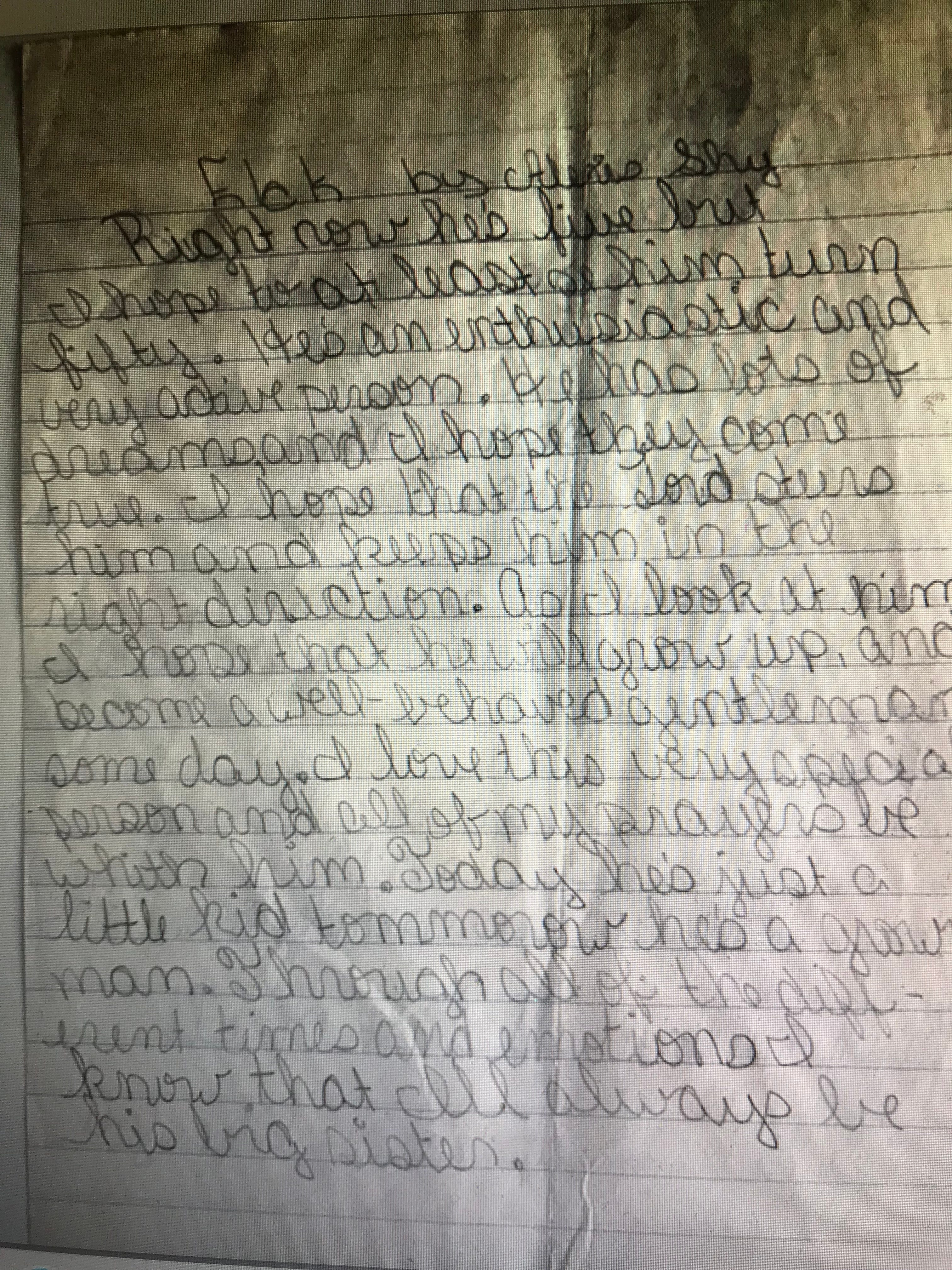
Transcription: Right now he's five but I hope to at least see him turn fifty. He's an enthusiastic and very active person. He has lots of dreams and I hope they come true. I hope that the Lord steers him and keeps him in the right direction. As I look at him, I hope that he will become a well-behaved gentleman some day. I love this very special person and all of my prayers be with him. Today he's a just a little kid and tomorrow he's a grown man. Through all of the different times and emotions, I will always be his big sister.
I was 11 years old when I wrote this. It wasn’t just a sweet message. It was a prayer. A declaration. I was capturing, as best I could as a child, what I sensed about his life and his destiny.
I didn’t know that’s what I was doing.
It was instinctive.
Eventually, as an adult, I began to recognize a pattern.
Writing wasn’t just processing.
It became a place where I met God.
I wasn’t generating insight.
I was recording it.
What I later learned is that Scripture has always made room for people who encounter God through words.
The Bible speaks of scribes not merely as record keepers, but as people entrusted with preserving, interpreting, and stewarding what God was saying.
Ezra is one of the clearest examples. He is described as “a scribe skilled in the Law of Moses” (Ezra 7:6). A few verses later, we’re told why: “Ezra had devoted himself to the study and observance of the Law of the Lord, and to teaching its decrees and laws” (Ezra 7:10).
That order matters.
Ezra studied the Word.
He lived it.
And then he taught it.
He wasn’t inventing revelation.
He was stewarding what had already been given.
Jesus affirms this role again in the New Testament when He speaks of scribes trained for the kingdom. He says they are like “the owner of a house who brings out of his storeroom new treasures as well as old” (Matthew 13:52).
This scripture has stayed with me.
Scribes don’t discard what’s old to chase what’s new.
And they don’t cling to the old in fear of the new.
They hold both.
They tend the storeroom.
They preserve truth long enough for others to receive it.
Looking back now, I can see that what felt like “just writing” was actually attentiveness. Writing trained me to slow down. To listen carefully. To stay with meaning long enough for it to form me.
Writing wasn’t my substitute for Scripture.
It was how Scripture began to come alive for me.
Not everyone encounters God the same way, and Scripture never suggests that we should.
Some hear God clearly in silence.
Some hear God clearly through prayer and deep intercession.
Some hear God through dreams and visions.
And some, like scribes, discern through words.
Through reading.
Through writing.
Through reflection that refuses to rush past meaning.
God doesn’t elevate one method above another.
He simply develops the one He gave you.
God didn’t wait for me to learn how I should learn.
He met me exactly where I was being me.
Reflection
Where has God been teaching you in ways that feel natural to you, but unfamiliar or undervalued by others?
This is a great reminder that God will meet us where we are, even when it comes to understanding His word. I remember when sermons actually started making sense when the history mentioned in school was also mentioned in sermons. For some reason it just helped things click for me!